


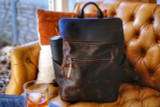


You’re about to drop real money on something somebody is calling “leather.” But is it actually leather?
That question has sent more good people into a confusing pile of labels than a toddler into a closet full of Christmas lights. Full grain. Top grain. Genuine. Bonded. Corrected grain. Split. It can sound fancy because fancy words are useful when you are trying to sell somebody a couch that will peel like a sunburned tourist in six months.
I’ve been making full grain leather goods for more than 20 years. I have walked through tanneries, sat with leather suppliers, visited factories in Mexico, smelled enough hides to know when a truckload is good before I get halfway through it. That may not sound like a superpower, but it has saved us from buying a lot of junk.
Here’s everything I know about the types of leather, why full grain leather is at the top of the pile, and why a label saying “genuine leather” should make you ask more questions.

First, A Cow Is Not a Flat Sheet of Plastic
A hide comes from an animal. It has scars, wrinkles, pores, insect bites, stretch marks, and little marks from a life actually lived. Nature does not do perfect repetition. Even my kids are completely different from each other, and they came from the same two people.
The best leather keeps that natural character. The cheaper stuff hides it, sands it off, paints over it, or grinds it into bits and glues it back together.
That is the basic story.
When people ask about leather grades, I put them in this order:
- Full grain leather
- Top grain leather
- Genuine leather
- Bonded leather
There are more technical names and subcategories, but this is the lineup that matters when you are buying a bag, wallet, belt, jacket, or something else you hope will not embarrass you next year.
Full Grain Leather: The Whole Honest Truth
What is full grain leather? It is the strongest, most durable part of a hide, with the natural grain still intact.
The outer surface has not been sanded down to erase its character. You can see pores, small scars, and natural variations. Some people see those marks and think something is wrong. Nothing is wrong. That is proof you are looking at the real deal.
At Saddleback, we use full grain leather because it is the only kind that can do what we want a bag to do. It needs to survive airports, rainstorms, office floors, campgrounds, motorcycle rides, kids, dogs, and whatever dumb thing you decide to carry in it.
I am not recommending you test that last part on purpose. If you’re going to be dumb, you’ve got to be tough.
Full grain leather has tightly packed fibers right below that natural surface. That makes it strong. Really strong. It also means it will not peel apart the way coated or heavily processed leather does.
And then there is the good part. Patina.
Your Bag Should Look Better on Its 10th Birthday Than Its First
Patina is the deep, rich change full grain leather gets through use, sunlight, the oils from your hands, a little dirt, a little adventure, and time. It is not damage. It is a record.
A full grain leather bag starts out handsome. Give it years and it becomes yours. The color deepens, the surface gains character, and every scratch and softened corner says something about where it has been.
Our Chestnut full grain leather begins as a red brown or reddish color and develops more depth with use. Tobacco begins as tan or light brown and darkens into something warm and worn-in. Dark Coffee Brown starts dark brown and gets richer, like good coffee or a well-told story that gets better every time your uncle tells it.
That is what real aging looks like. Not worse. Better. Richer. More personal.

Top Grain Leather: Still Leather, But It Left Something Important Behind
Top grain leather begins as the top portion of the hide, but the natural outer grain is sanded or buffed down. After that, manufacturers often apply a finish, pigment, or embossed pattern to make the surface look more uniform.
Why do they do it? Because hides have natural marks, and uniformity is easier to sell when somebody has decided every bag should look like it came out of a machine. Also, lower-quality hides can be made to look smoother than they really are.
Top grain leather is not fake. It can be a decent material. But once you remove the strongest outer layer, you have removed part of the hide’s durability and most of its ability to develop a real patina.
It will usually look more perfect at the beginning. That is its trick.
But over time, that coated surface can crack, wear thin, or look tired. It ages the way a PT Cruiser ages. Badly.
Full grain leather tells the truth about itself. Top grain leather puts on makeup for picture day.
“Corrected Grain” Is Not a Compliment
You may also see “corrected grain” on product descriptions. That generally means the surface was sanded, corrected, covered, and given a new artificial grain pattern.
Think of it as a toupee in a windstorm. It may look convincing from across the room, but it gets suspicious fast when life happens.
Some sellers use a beautiful product photo and call it “premium leather” without telling you what kind. That is not an accident. If a company will not plainly say full grain leather, then it probably is not full grain leather.
Ask them. A good answer should not require a law degree and a decoder ring.
Genuine Leather: The Name Is Doing a Lot of Work
“Genuine leather” sounds like it should be great. Genuine means real, right?
Technically, yes. Genuine leather is technically true the same way a hot dog is technically food.
Genuine leather usually comes from lower layers of the hide after the stronger top portion has been separated. It is often processed, painted, coated, and embossed to look like a nicer type of leather.
It is real animal hide. I will give it that. But it is not the top-tier material the words make people imagine.
This is one of the oldest tricks in the book. Put a reassuring word on a label, keep the explanation fuzzy, and hope the customer does not know the leather hierarchy.
Now you do.
A “genuine leather” wallet can look good in a store. Then it gets bent, stuffed into pockets, sat on, sweated on, and generally asked to do wallet things. Before long, it can crack at the folds or separate where the coating gives up.
That is not a legacy item. That is a future trash can resident.

Bonded Leather: The Particle Board of the Leather World
Bonded leather is the particle board of the leather world.
It is made from scraps, fibers, and dust left over from hide processing. Those leftovers are ground up, mixed with glue or polyurethane, pressed into sheets, and then finished to look like leather.
Again, there may be some leather in there. There is also a little bit of leather in the dust at the bottom of a tannery floor. That does not make it a bag.
Bonded leather is common in cheap furniture, bargain belts, inexpensive notebooks, and products that need to look fancy long enough to get through a product photo. It tends to peel, flake, crack, and disappoint.
Have you ever seen a couch shedding brown flakes all over somebody’s living room? That is bonded leather waving goodbye.
I have watched people buy something because it was cheap, then replace it a year or two later because it fell apart. Buy cheap, buy twice. Buy quality, buy once.
The Math Always Works Out
Somebody will say, “But a full grain leather bag costs more.”
Correct. Good things usually do.
Let’s do the math. A $500 full grain leather bag that lasts 20 years costs you $25 per year. A $50 bag that lasts one year costs $50 per year, and then you have to shop again, break in another bag, and explain to your wife why you have three broken bags in the closet.
I am no math genius. Just ask my brother. But $25 is less than $50.
The cheaper bag may feel like the bargain on Tuesday. Twenty years later, the full grain leather bag is still carrying your stuff, has a story, and may be something your kid actually wants. The cheap bag is in a landfill wearing a fake grain pattern.
That is why our warranty is 100 years. We do not make products that are supposed to die young. We make things they’ll fight over when you’re dead.
Why We Show You How to Knock Off a Bag
Years ago, I made a video called How to Knock Off a Bag. I showed people exactly how someone could copy our designs.
People thought I had lost my mind. Maybe I had. It would not be the first time.
But the point was simple: a design can be copied. A buckle shape can be copied. A pocket layout can be copied. Even a logo can be copied by somebody with bad intentions and enough time.
What is much harder to copy is our commitment to full grain leather, over-engineered construction, good hardware, industrial stitching, and the willingness to stand behind the thing for a century.
A bag is more than its silhouette. It is the materials, the people making it, and what happens after you have used it hard for 10 years.
We are a people business cleverly disguised as a leather bag company. The bag is just where that promise gets carried around.
How to Tell What You’re Actually Buying
You do not need to become a tannery expert. You just need to ask a few plain questions.
Look for Specific Words
A company selling full grain leather should say “full grain leather.” Clearly. Not “premium leather.” Not “luxury leather.” Not “high-quality genuine leather,” which is a phrase that makes my eye twitch.
Specificity is honesty.
Look at the Cut Edges
On a cut edge of full grain leather, you should see dense leather fibers. It should not look like cardboard, layers of plastic, or a fuzzy pressed sandwich.
At Saddleback, we leave edges visible on many products specifically because it proves the leather quality. We are basically showing off. Proudly.
Expect Variation
Full grain leather will not be perfectly identical from one bag to the next. That is a feature, not a flaw.
If every piece has identical grain, identical color, and identical fake-looking perfection, somebody probably did a lot of correcting. Cows are not manufactured in a printer. Thank goodness.
Use Your Nose and Your Hands
Real full grain leather has a distinctive, natural smell. It feels substantial. It may have wrinkles and marks. It warms up in your hand.
Bonded leather and heavily coated leather can smell like chemicals, plastic, or that aisle of a discount store where everything is pretending to be something else.
The Leather Hierarchy, One More Time
Here is the simple version:
- Full grain leather: The strongest, most natural part of the hide. It develops a beautiful patina and can last generations.
- Top grain leather: Sanded and refinished for a uniform look. Still real leather, but less durable and less likely to age well.
- Genuine leather: Usually lower-quality layers, heavily processed and dressed up with a label that sounds better than it is.
- Bonded leather: Leather scraps and fibers glued together. The particle board of the leather world.
There are exceptions and technical details, because leather is an old craft and people have been finding new names for things since probably five minutes after the first cow. But if you remember that list, you will be ahead of most shoppers.
Buy Something With a Future
I have carried leather bags through airports in Mexico, on road trips, into meetings, through rain, and into enough coffee shops to make a barista nervous. The best ones do not stay pristine. They become better because they were used.
That is what full grain leather is for. Not sitting on a shelf. Living a life with you.
So before you buy, look past the pretty photo and the vague words. Ask what type of leather it is. Ask whether it is full grain leather. Ask what happens after five years, not just on day one.
Then go grab the bag you already own, look at its scratches and scars, and tell us where it has been. Or tell us the worst “genuine leather” purchase you ever made. We can all learn from it. Especially the guy who bought a $50 bag twice.